

Merritt Wever is one of the most genuinely extraordinary actresses working in American film and television today — and one of the most stubbornly underknown, which is in some ways exactly how she prefers it. She has won three Primetime Emmy Awards across three different categories in three different decades, covering comedy, limited series drama, and guest drama performance. She has appeared in Academy Award-winning films, landmark prestige television, and independent cinema with a consistency of quality that few of her peers can match. And she delivered what is widely considered the greatest Emmy acceptance speech in the award’s history — eleven words, delivered with perfect timing, and then she was gone.
Biography / Wiki Table
| Detail | Information |
|---|---|
| Full Name | Merritt Carmen Wever |
| Date of Birth | August 11, 1980 |
| Age (2025) | 44 years old |
| Place of Birth | New York City, New York, USA |
| Raised In | Downtown Manhattan, New York City |
| Nationality | American |
| Mother | Georgia Wever (raised her alone; Texas-born; politically progressive) |
| Conceived Via | Sperm donor (father not publicly known) |
| Height | 5 ft 3 in (160 cm) |
| Eye Color | Blue |
| Hair Color | Brown |
| Pet | Cat named Spooky |
| High School | Fiorello H. LaGuardia High School, Manhattan (graduated 1998) |
| University | Sarah Lawrence College (graduated 2002) |
| Childhood Activity | Children’s choir, Metropolitan Opera, New York City |
| Political Stance | Openly progressive (raised by politically progressive mother) |
| Social Media | Absent from Instagram, Twitter, Facebook — no official accounts |
| Relationship Status | Very private; no confirmed public relationships |
| Children | None confirmed |
| Known For | Nurse Jackie (Showtime), Godless (Netflix), Unbelievable (Netflix), Severance (Apple TV+), Birdman, Marriage Story |
| Three Emmy Wins | 2013 (Nurse Jackie), 2018 (Godless), 2025 (Severance) |
| Golden Globe Nomination | 2020 — Best Actress, Limited Series (Unbelievable) |
| Stage Work | Off-Broadway: The Illusion (Signature Theatre); Uncle Vanya (SoHo Rep); The Nether (MCC) |
| Upcoming | The Gilded Age Season 4 (HBO, 2026) |
| Net Worth (est.) | Approximately $5 million |
| IMDb | nm0923266 |
Early Life: Downtown New York and the Metropolitan Opera
Merritt Carmen Wever was born on August 11, 1980, in New York City, and grew up in downtown Manhattan — the beating cultural heart of one of the world’s great arts capitals — raised by her mother Georgia Wever, a Texas-born woman who raised her alone and instilled in her daughter a politically progressive consciousness and a deep respect for artistic expression. Merritt was conceived via sperm donor, a fact she has not hidden, and was raised in a household shaped by her mother’s independence, intelligence, and commitment to the values that defined their home.
Growing up in downtown Manhattan in the 1980s and early 1990s meant growing up surrounded by the full spectrum of New York’s cultural life — the theatre, the independent film scene, the visual arts, the music, and all the layered complexity of a city in which genuine artistic ambition was simply part of the atmosphere. For a child with Merritt’s gifts, it was an extraordinary environment in which to discover what she was capable of.
That discovery came early. As a child, she sang in the children’s choir of the Metropolitan Opera — one of the most prestigious musical institutions in the world, housed at Lincoln Center, whose children’s chorus performs in full productions alongside professional singers. The experience placed her, from childhood, in the midst of professional artistic performance at its most demanding and most serious level. She learned, before she was ten years old, what it felt like to be part of something larger than herself — to contribute to a work of art that required total commitment and total presence from every person involved.
LaGuardia High School and Sarah Lawrence College
After the Metropolitan Opera choir, Merritt Wever continued building her artistic foundation through the institution that has shaped more significant American performers than perhaps any other single school: Fiorello H. LaGuardia High School for Music & Art and Performing Arts in Manhattan. LaGuardia — the school on which the film and television series Fame was based — is a public arts high school that requires audition for admission and produces a remarkable proportion of the significant actors, musicians, dancers, and visual artists who have emerged from New York in the modern era.
She graduated from LaGuardia in 1998, having spent four years in one of the most stimulating and demanding arts environments available to a young performer anywhere in the world. She then enrolled at Sarah Lawrence College in Bronxville, New York — a small, intensely creative liberal arts college known for its commitment to independent learning, interdisciplinary study, and the cultivation of individual artistic voice rather than standardised academic performance. Sarah Lawrence has a long history of producing writers, artists, and performers whose work is characterised by intellectual depth and creative independence, and Merritt graduated with her degree in 2002.
Crucially, she had already begun working professionally while still a student. Her first film credit — The Adventures of Sebastian Cole (1998), an independent coming-of-age drama — came in her graduation year from LaGuardia, and she appeared in the dark comedy Series 7: The Contenders (2001) while still attending Sarah Lawrence. She arrived at professional acting fully formed in ways that the most formal conservatory training does not always produce, because she had been training in the most serious possible environments since childhood.
Early Career: Signs, Into the Wild, and Michael Clayton
The years between her Sarah Lawrence graduation and her breakthrough on Nurse Jackie were characterised by exactly the kind of careful, quality-focused work that her entire subsequent career would continue to reflect. Merritt Wever appeared in M. Night Shyamalan’s Signs (2002) — the supernatural thriller starring Mel Gibson and Joaquin Phoenix — in a small but credited role that placed her in one of the year’s most commercially successful films.
She appeared in Into the Wild (2007) — Sean Penn’s critically acclaimed adaptation of Jon Krakauer’s book about Christopher McCandless, starring Emile Hirsch — in a supporting capacity, working alongside a director whose commitment to authentic, emotionally rigorous storytelling aligned naturally with her own artistic instincts.
The same year brought Michael Clayton — Tony Gilroy’s legal thriller starring George Clooney as a fixer at a major New York law firm, with a supporting cast including Tilda Swinton, Tom Wilkinson, and Sydney Pollack. The film received seven Academy Award nominations including Best Picture, and Tilda Swinton won for Best Supporting Actress. Working in this environment — at the highest level of studio drama, with this calibre of director and ensemble — was another marker of the professional trajectory Wever was building long before her name was widely known.
Her stage work during this period included Off-Broadway productions at Signature Theatre Company (The Illusion, Tony Kushner’s adaptation of Corneille) and SoHo Rep (Uncle Vanya), confirming her commitment to theatre as a sustained part of her artistic practice rather than a career stepping stone to be abandoned once screen work arrived.
Merritt Wever Shows: Nurse Jackie, Zoey Barkow, and the Emmy Speech Heard Round the World
In 2009, Merritt Wever was cast as Zoey Barkow in Nurse Jackie — Showtime’s medical comedy-drama starring Edie Falco as Jackie Peyton, a brilliant emergency room nurse managing a devastating drug addiction in a New York City hospital. The show ran for seven seasons from 2009 to 2015 and is widely regarded as one of the finest character studies in the history of American television, built around Falco’s extraordinary central performance and the ensemble that surrounded her.
Zoey is Jackie’s endlessly enthusiastic, slightly overwhelming, deeply warm nursing student and eventual colleague — the character whose transparent goodness and genuine love for nursing provides both a comic counterpoint to Jackie’s moral complexity and an emotional anchor for the audience’s investment in the show’s world. She is funny in a way that requires real precision — the comedy of someone who does not know they are being funny, who is in complete earnest at every moment, whose enthusiasm is genuine rather than performed. Playing this kind of character without condescension, without reducing her to a joke, while simultaneously making her the most morally reliable person in a show full of moral complexity, is a specific and demanding craft achievement.
Wever was nominated for the Emmy for Outstanding Supporting Actress in a Comedy Series in 2012. She was nominated again in 2013. And in 2013, she won.
She walked to the podium. She looked at the audience. And she said, approximately: “Thanks so much. Thank you so much. I gotta go. Bye.”
Then she left.
The speech — eleven words, delivered with the precise timing of someone who understood exactly what she was doing and chose to do it anyway — became one of the most celebrated moments in the history of the Emmy Awards. It has been cited repeatedly as the greatest Emmy acceptance speech ever given: funnier than any joke, more memorable than any prepared remarks, and truer to its speaker’s character than anything a speechwriter could have produced. It said, in eleven words, everything that needed to be said about a performer who has always let the work speak for itself.
The Walking Dead: Denise Cloyd and the LGBT Community Controversy
In 2015–2016, Merritt Wever appeared in a recurring capacity on AMC’s The Walking Dead — the post-apocalyptic horror drama that was, at that point, one of the most watched shows on American cable television — as Dr. Denise Cloyd, a physician and one of the show’s first openly gay characters in a romantic relationship.
Denise was introduced as a cowardly, uncertain doctor who gradually developed courage and competence under the pressure of the zombie apocalypse, and her relationship with Tara Chambler (Alanna Masterson) was warmly received by LGBT audiences who had invested meaningfully in the representation it offered. Her death — sudden, graphic, and written in a way that many critics and fans identified as an instance of the “Bury Your Gays” trope (in which LGBT characters are disproportionately killed off in fiction) — generated significant controversy and social media outrage that extended well beyond the show’s usual audience.
The controversy was not of Wever’s making — it was a writers’ room decision that she had no control over — but her performance of Denise’s arc, including the character’s final moments, was universally praised. The episode generated more discussion about representation, storytelling responsibility, and the specific harms of narrative patterns that punish LGBT characters for the crime of existing than almost any other single episode in the show’s run.
Godless (2017): Mary Agnes McNue and Emmy Win Number Two
The role that established Merritt Wever as a dramatic powerhouse rather than solely a comic performer was Mary Agnes McNue in Godless — Scott Frank’s 2017 Netflix Western miniseries set in the New Mexico Territory of the 1880s, where a town populated almost entirely by women after a mining disaster confronts an outlaw gang. The ensemble cast included Jeff Daniels, Jack O’Connell, Michelle Dockery, and Thomas Brodie-Sangster.
Mary Agnes is the de facto leader of La Belle, the female-dominated town — a tough, complex, multilayered woman whose authority over the community is earned rather than inherited, whose personal history includes a previous identity that the town has accepted without fanfare, and whose love for the women and children in her care is the driving moral force of everything she does. She is a character of genuine complexity and genuine historical resonance — a woman who would not have been permitted to occupy any official position of authority in the actual American West of the 1880s, and who has found a way to lead anyway.
Wever has spoken about the terror she felt approaching the role: “I spent so much of this shoot thinking I would come off as a fool, that nobody would buy me as this and it wouldn’t be believable.” The self-doubt she describes is the authentic anxiety of a serious artist confronting material that demands everything they have and wondering whether what they have will be enough.
It was enough. Entertainment Weekly wrote that “no one is more electric than the always extraordinary Merritt Wever” in the show. At the 2018 Emmy Awards, she won Outstanding Supporting Actress in a Limited Series or Movie — her second Emmy, in a completely different category from the first, confirming the range that those who had followed her career closely had always known was there.
Unbelievable (2019): True Crime Drama and the Golden Globe Nomination
In 2019, Merritt Wever starred in Unbelievable — the Netflix limited series based on the true story of Marie Adler, a young woman whose rape report was disbelieved by police, and the two female detectives who eventually proved the rapist’s guilt. She played Detective Karen Duvall opposite Toni Collette’s Detective Grace Rasmussen — two women from different jurisdictions whose collaboration cracks a case that systemic failure had allowed to continue.

The show received extraordinary critical acclaim, and Wever’s performance earned her her first Golden Globe nomination for Best Actress in a Limited Series or Television Film — a recognition that acknowledged she was now operating as a lead performer rather than an ensemble player, carrying the weight of a dramatic narrative rather than enhancing someone else’s.
The show’s subject matter — institutional disbelief of rape survivors, systemic failures in law enforcement, and the specific courage of the women who pursue justice in the face of those failures — resonated powerfully with audiences and generated the kind of sustained cultural conversation that the best true crime storytelling produces when it is made with genuine care and moral seriousness.
Run (2020), Tiny Beautiful Things (2023), and Continued Range
Merritt Wever starred opposite Domhnall Gleeson in Run (2020) — the HBO comedy thriller about two former college sweethearts who make a pact to drop their adult lives and run away together if either texts “RUN” — a premise that sounds like a romantic comedy and reveals itself, with characteristic complexity, to be something considerably darker and more interesting. The show was cancelled after one season.
In 2023, she appeared in Tiny Beautiful Things — the Hulu limited series adapted from Cheryl Strayed’s book of the same name, based on Strayed’s experiences writing the “Dear Sugar” advice column for The Rumpus. The show starred Kathryn Hahn in the central role of Clare / Sugar, with Wever in a supporting capacity. Her performance earned her a Primetime Emmy nomination for Outstanding Supporting Actress in a Limited or Anthology Series or Movie — her fourth Emmy nomination, confirming that the recognition for her work was, if anything, accelerating rather than plateauing.
Severance (Apple TV+, 2025): Emmy Win Number Three
In 2025, Merritt Wever added a third Emmy Award to her collection — and did so in a third different category, a feat that speaks to a range and consistency that the Emmy voters have now formally acknowledged across comedy, drama limited series, and guest drama performance. She appeared in Severance — Apple TV+’s psychological thriller about office workers who undergo a medical procedure to separate their work and personal memories — in a guest capacity during the show’s second season.
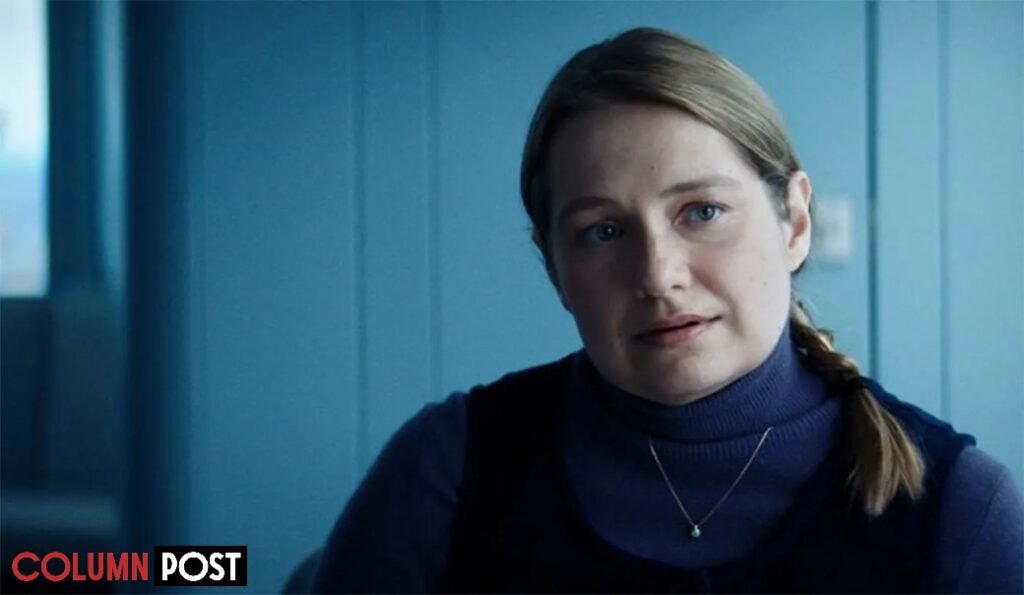
Her performance was precise, controlled, and deeply unsettling in the way that the best work in Severance tends to be — the show demands a specific quality of deadpan existential dread from its performers, and Wever brought exactly that while simultaneously humanising a character whose circumstances are profoundly inhuman. The Emmy win for Outstanding Guest Actress in a Drama Series was her third, making her one of a very small number of performers to win Emmy Awards in three distinct categories.
| Emmy Win | Category | Show | Year |
|---|---|---|---|
| Win #1 | Outstanding Supporting Actress — Comedy Series | Nurse Jackie | 2013 |
| Win #2 | Outstanding Supporting Actress — Limited Series or Movie | Godless | 2018 |
| Win #3 | Outstanding Guest Actress — Drama Series | Severance | 2025 |
Film Career: The Academy Award Rooms
Alongside her television work, Merritt Wever has built a film career of remarkable prestige — not in terms of blockbuster commercial success, but in terms of the quality of directors, projects, and ensembles she has consistently chosen to be part of.
| Year | Film | Director / Notable Cast |
|---|---|---|
| 1998 | The Adventures of Sebastian Cole | Tod Williams |
| 1998 | All I Wanna Do (The Hairy Bird) | Sarah Kernochan |
| 2001 | Series 7: The Contenders | Daniel Minahan |
| 2002 | Signs | M. Night Shyamalan; Mel Gibson, Joaquin Phoenix |
| 2007 | Into the Wild | Sean Penn; Emile Hirsch |
| 2007 | Michael Clayton | Tony Gilroy; George Clooney, Tilda Swinton |
| 2009 | The Messenger | Oren Moverman; Ben Foster, Woody Harrelson |
| 2010 | Greenberg | Noah Baumbach; Ben Stiller |
| 2010 | Tiny Furniture | Lena Dunham (independent debut) |
| 2012 | 6 Balloons | — |
| 2014 | Birdman | Alejandro G. Iñárritu; Michael Keaton, Emma Stone |
| 2015 | Meadowland | Reed Morano |
| 2018 | Welcome to Marwen | Robert Zemeckis; Steve Carell |
| 2018 | Irreplaceable You | Stephanie Laing |
| 2018 | Charlie Says | Mary Harron |
| 2019 | Marriage Story | Noah Baumbach; Adam Driver, Scarlett Johansson |
Birdman (2014) — Alejandro G. Iñárritu’s stunning, technically audacious film about a faded superhero actor attempting a Broadway comeback, shot to appear as a single unbroken take — won four Academy Awards including Best Picture and Best Director. Wever appeared in the ensemble alongside Michael Keaton, Emma Stone, Edward Norton, Naomi Watts, and Zach Galifianakis. Being part of the Best Picture-winning ensemble is a significant career credential by any measure.
Marriage Story (2019) — Noah Baumbach’s devastating and beautiful film about a marriage dissolving through a contentious divorce, starring Adam Driver and Scarlett Johansson — was one of the most praised films of that year, nominated for six Academy Awards and receiving Scarlett Johansson’s first Oscar nomination. Wever played Cassie, a divorce attorney, in a scene that became one of the film’s most discussed — bringing her characteristic quality of warm, slightly bewildering human specificity to a brief appearance that landed with memorable force.
Tiny Furniture (2010), written and directed by Lena Dunham as her debut feature, was an early independent credit that connected Wever to one of the decade’s most significant emerging voices in American independent film — a relationship that speaks to the quality of her industry relationships and her instinct for spotting significant work before it becomes widely recognised.
Stage Work: The Theatre That Sustains Everything
One of the most important but least publicised dimensions of Merritt Wever’s professional life is her sustained commitment to stage work throughout a career that has offered every possible incentive to abandon it. Theatre does not pay what television and film pay. It does not generate the same public profile. It does not offer the same long-term income security.
She has returned to it consistently anyway — appearing in Off-Broadway productions at Signature Theatre Company (Tony Kushner’s The Illusion), SoHo Rep (Chekhov’s Uncle Vanya), and MCC Theater (The Nether). The discipline, technical rigour, and specific quality of presence that live performance demands are visible in everything she does on screen — in the completeness of her characters, the precision of her timing, and the quality of listening that characterises all of her best work.
The Private Person Behind the Public Performance
One of the most distinctive aspects of Merritt Wever’s public profile is how little of it exists by design. She is absent from all major social media platforms — no confirmed Instagram, no Twitter, no Facebook. She does not give extensive personal interviews. She does not discuss her romantic life or family situation in the media. She raised no public controversy around her personal circumstances, including her origins as the child of a single mother and sperm donor, which she disclosed without drama and has not made a public talking point.
Her IMDb biography offers a few glimpses of who she is outside of work: she spends time with her cat Spooky, goes to the theatre with friends, likes to eat steak, drink a little wine, walk in the snow, and talk to Canadians. These details — specific, quirky, unperformed — are entirely consistent with everything else known about her: a person of genuine individuality who does not curate her public persona, and whose privacy is not a defensive posture but simply a natural expression of who she is.
The political progressivism instilled by her Texas-born mother expresses itself in her activism — she has been described as someone who, when not acting, is protesting. The specific causes and specific events are not matters of public record, but the disposition — the belief that artistic work and civic engagement are not separate activities — is entirely consistent with the artistic seriousness that characterises her approach to everything she does.
The Gilded Age Season 4: What Comes Next
In February 2026, it was announced that Merritt Wever had joined the cast of The Gilded Age for its fourth season — HBO’s costume drama set in 1880s New York City, created by Julian Fellowes and starring Carrie Coon, Christine Baranski, Morgan Spector, and a cast heavily populated by Broadway and stage veterans. The show has built a devoted following across its first three seasons for its richly detailed recreation of Gilded Age New York society and its intelligent examination of the class dynamics, political tensions, and social transformations of the period.
Wever’s casting adds a performer of extraordinary calibre to an already remarkable ensemble — a three-time Emmy winner with deep roots in the New York theatrical world joining a production that has consistently drawn on exactly that tradition. The announcement is another marker of where her career stands: not as a performer seeking a prominent role in a prestigious production, but as one whose involvement elevates the production’s status in the eyes of both the industry and the audience.
What Three Emmys in Three Categories Tell Us
The career of Merritt Wever defies easy summary because it defies easy categorisation. She is not a comedy actress who occasionally tries drama, or a drama actress who occasionally does comedy. She is a complete performer whose range encompasses the full spectrum of what American screen acting demands — from the precisely calibrated absurdist warmth of Zoey Barkow to the frontier authority of Mary Agnes McNue to the procedural intelligence of Detective Karen Duvall to the existential unease she brought to Severance.
The three Emmy Awards in three categories are the clearest possible official acknowledgement of this range — a record that almost no other performer in the award’s history can match across the specific combination of comedy, limited drama, and guest drama that her wins cover.
She has done all of this without social media, without a carefully managed public profile, without the kind of promotional machinery that most contemporary careers are built around. She shows up. She does the work. She wins the Emmy. She says “I gotta go. Bye.” And then she is gone.
It is, in the most complete sense of the phrase, exactly enough. For anyone still discovering the full range of merritt wever shows — from Nurse Jackie to Godless to Unbelievable to Severance — the journey is one of the most rewarding in modern American television.
Complete Career Timeline
| Year | Milestone |
|---|---|
| August 11, 1980 | Born in New York City |
| Childhood | Sings in children’s choir, Metropolitan Opera, Lincoln Center |
| 1994–1998 | Attends Fiorello H. LaGuardia High School for the Performing Arts |
| 1998 | Graduates LaGuardia; film debut in The Adventures of Sebastian Cole |
| 1998–2002 | Attends Sarah Lawrence College |
| 2001 | Appears in Series 7: The Contenders while at Sarah Lawrence |
| 2002 | Graduates Sarah Lawrence; appears in Signs (M. Night Shyamalan) |
| 2006–2007 | Recurring role in Studio 60 on the Sunset Strip (NBC, Aaron Sorkin) |
| 2007 | Appears in Into the Wild (Sean Penn) and Michael Clayton (Tony Gilroy) |
| 2009 | Joins Nurse Jackie (Showtime) as Zoey Barkow |
| 2010 | Appears in Greenberg (Noah Baumbach) and Tiny Furniture (Lena Dunham) |
| 2011 | Off-Broadway in The Illusion (Signature Theatre, Tony Kushner) |
| 2012 | First Emmy nomination for Nurse Jackie |
| 2013 | Wins first Emmy for Nurse Jackie; delivers legendary 11-word speech |
| 2013 | Recurring role in New Girl (Fox) as Elizabeth |
| 2014 | Appears in Birdman (Iñárritu; wins Best Picture) |
| 2015 | Nurse Jackie concludes; joins The Walking Dead as Denise Cloyd |
| 2016 | Denise Cloyd killed off The Walking Dead; controversy follows |
| 2017 | Stars in Godless (Netflix) as Mary Agnes McNue |
| 2018 | Wins second Emmy for Godless; appears in Marriage Story, Welcome to Marwen |
| 2019 | Stars in Unbelievable (Netflix); Golden Globe nomination |
| 2020 | Stars in Run (HBO) opposite Domhnall Gleeson; cancelled after one season |
| 2022 | Guest appearances across various productions |
| 2023 | Appears in Tiny Beautiful Things (Hulu); fourth Emmy nomination |
| 2025 | Guest role in Severance (Apple TV+); wins third Emmy (Outstanding Guest Actress, Drama) |
| February 2026 | Announced for The Gilded Age Season 4 (HBO) |