


| Quick Facts | Details |
|---|---|
| Full Name | Tracy Jo Pollan Fox (née Pollan) |
| Date of Birth | June 22, 1960 |
| Birthplace | Long Island, New York, USA |
| Raised | Woodbury, New York (Long Island) |
| Age (2026) | 65 years old |
| Height | 5 ft 5 in (1.67 m) |
| Nationality | American |
| Heritage | Russian Jewish — raised in the faith |
| Father | Stephen Michael Pollan — financial consultant and writer |
| Mother | Corinne Elaine “Corky” (Staller) Pollan — magazine editor |
| Brother | Michael Pollan — author (The Omnivore’s Dilemma, In Defense of Food, How to Change Your Mind); UC Berkeley journalism professor |
| Siblings | Also two sisters |
| Education | Syosset High School; The Dalton School, Manhattan |
| Acting training | Herbert Berghof Studio (HB Studio); Lee Strasberg Theatre Institute |
| Film debut | Baby It’s You (1983) — John Sayles |
| Breakthrough | Ellen Reed — Family Ties Season 4 (1985–1986); returned Season 5 finale (1987) |
| Key films | Promised Land (1987); Bright Lights, Big City (1988); A Stranger Among Us (1992, Sidney Lumet) |
| Key TV movies | The Kennedys of Massachusetts (1990, as Kathleen Kennedy); Fine Things (Danielle Steel); First to Die (James Patterson); Natalee Holloway (2009, Lifetime); Justice for Natalee Holloway (2011) |
| Emmy nomination | Outstanding Guest Actress Drama Series — Harper Anderson, Law & Order: SVU (2000) |
| Other TV | Spin City (Renee Miller, 2 episodes); Medium; The Michael J. Fox Show (2013) |
| Cookbooks | The Pollan Family Table (2014, NYT Bestseller, with Corky + 2 sisters); Mostly Plants (2019, flexitarian) |
| Met Michael | Family Ties set 1985 — reconnected during Bright Lights, Big City 1987 |
| Married | July 16, 1988 — Manhattan |
| Marriage duration | 37+ years (as of 2026) |
| Son | Sam Michael Fox (b. May 30, 1989) |
| Twins | Aquinnah Kathleen Fox and Schuyler Frances Fox (b. February 15, 1995) |
| Youngest | Esmé Annabelle Fox (b. November 3, 2001 — Tracy was 41) |
| Philanthropy | Michael J. Fox Foundation — actively involved; ran Brooklyn Half Marathon sign holder May 2024 |
| Interests | Cooking; organic/plant-based eating; gardening; fitness; travel |
| Residence | Manhattan, New York |
| Michael’s net worth | $65 million (combined household) |
| Tracy’s net worth (est.) | $20 million (independent estimate) |
There is a specific kind of biographical subject who is simultaneously one of the most important people in a famous person’s story and one of the least documented people in their own right — whose significance to the larger narrative is total and whose individual biography the public record has not quite kept pace with. Tracy Pollan is that subject.
She is the woman who played Michael J. Fox’s character’s love interest on Family Ties in 1985 — who filmed the scenes, maintained the professional relationship, and left the show without either of them having acted on whatever the set chemistry produced. She is the woman who appeared opposite him in Bright Lights, Big City two years later and found, in that second professional encounter, the specific clarity that the first had not quite produced. She is the woman who married him on July 16, 1988, and who has been married to him for thirty-seven years — through the Back to the Future trilogy’s global success, through a Parkinson’s diagnosis he kept private for seven years, through the disclosure, through the Foundation, through four children, through the advancing disease’s present reality, and through every dimension of a shared life whose public surface has always been considerably smaller than its private depth.
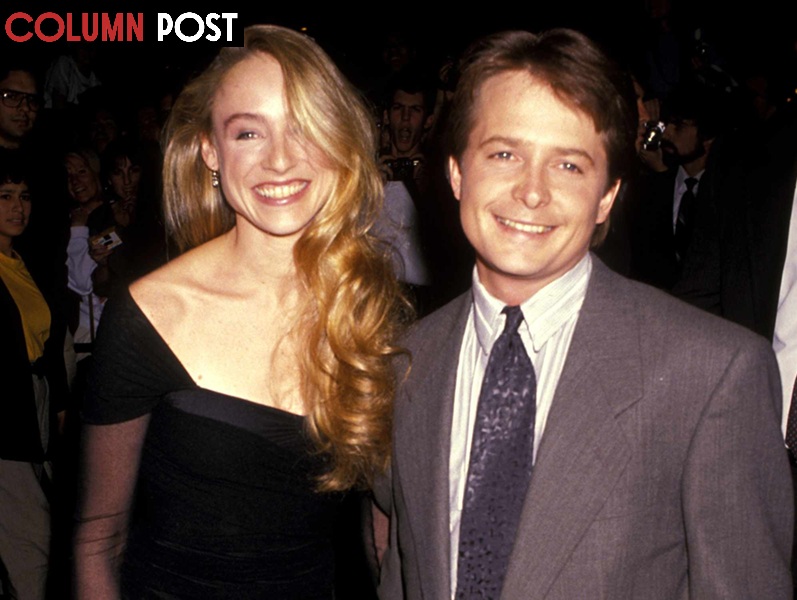
She has her own biography — the Long Island childhood, the Dalton School education, the HB Studio training, the John Sayles film debut, the Sidney Lumet picture, the Emmy nomination, the New York Times bestselling cookbook. She has a brother named Michael Pollan whose books about food and consciousness have made him one of the most influential writers in American journalism. She was forty-one years old when her youngest daughter was born. She held a handmade sign at the finish line of the Brooklyn Half Marathon in May 2024 while two of her daughters ran thirteen miles for their father’s Foundation.
The story of Tracy Pollan is the story of a genuinely accomplished person whose specific decision to build her life around her family rather than around her career has produced, over thirty-seven years, something considerably more durable than most careers produce — and whose own professional accomplishments deserve documentation on their own terms.
Woodbury, Long Island: The Pollan Family
Tracy Jo Pollan was born on June 22, 1960, in Long Island, New York — the Nassau County suburban community whose specific character, shaped by the postwar Jewish professional class’s migration from Brooklyn and the Bronx into the leafy suburbs that the GI Bill and the Midcentury economy had made accessible, gave her the formation of someone whose intellectual ambitions were taken for granted and whose specific cultural identity was Russian Jewish by heritage and New York by orientation.
She grew up in Woodbury — the hamlet in Nassau County whose excellent school system and comfortable professional-family character reflected the specific aspirations of a household headed by two people whose professional identities were built around words and ideas. Her father, Stephen Michael Pollan, was a financial consultant and writer whose career combined the practical intelligence of financial advice with the writerly sensibility of someone who understood that money was a subject with narrative dimensions as well as numerical ones. Her mother, Corinne Elaine “Corky” Pollan — née Staller — was a magazine editor whose professional identity shaped the household’s cultural consumption and whose collaboration with Tracy on their subsequent cookbook project reflects a relationship between mother and daughter that has been sustained across decades of professional and personal life.
The Pollan siblings who emerged from this household represent one of the more remarkable examples of a family’s collective intellectual output in recent American cultural life. Her brother Michael Pollan — who attended the same Long Island schools before going on to Bennington College and Columbia’s journalism programme — became one of the most influential writers on food, agriculture, and consciousness in American non-fiction: The Omnivore’s Dilemma (2006), In Defense of Food (2008), and How to Change Your Mind (2018) are the three works whose combined impact on American eating habits, food policy debate, and the scientific discussion of psychedelics have made him a genuine public intellectual rather than merely a successful author. He teaches at the University of California, Berkeley’s Graduate School of Journalism. Tracy also has two sisters — who would eventually become her co-authors on the family cookbook project — whose individual careers and identities the family has maintained with the specific privacy that the Pollan household generally practices.
The Jewish heritage — Russian Jewish family background, raised in the faith — gave Tracy both the specific cultural identity of the New York Jewish professional class and the intellectual tradition whose emphasis on learning, questioning, and the sustained engagement with ideas that the family’s collective output consistently reflects.
The Dalton School and the Decision to Act
Tracy Pollan attended Syosset High School on Long Island before transferring to The Dalton School in Manhattan — the prestigious private school on the Upper East Side whose alumni include Claire Danes, Anderson Cooper, and multiple other figures from the arts and media, and whose educational philosophy emphasises student initiative, intellectual independence, and the development of individual voice alongside academic rigour.
The move from Syosset to Dalton represents the specific transition from the Long Island suburban world of her childhood to the Manhattan cultural world that her professional aspirations required proximity to — and the school’s specific community of artistically and intellectually serious young people gave her the social environment in which her performing ambitions found their natural expression.
After Dalton, she pursued the acting training that her ambitions required through two of New York’s most respected institutions. The Herbert Berghof Studio — HB Studio — on Bank Street in the West Village was founded by Herbert Berghof and Uta Hagen, whose approach to acting training emphasised the specific technical competence of the working theatre actor: scene study, character analysis, vocal and physical work grounded in genuine craft rather than celebrity aspiration. Tracy subsequently trained at the Lee Strasberg Theatre Institute — the Method acting school whose approach, derived from Stanislavski and developed through Strasberg’s specific American interpretation, gave her the emotional preparation that the more technically demanding television and film work of her subsequent career required.
The combination of HB Studio’s craft focus and the Strasberg Institute’s emotional depth gave her the specific double foundation that the best-trained American actors of her generation consistently demonstrate — the ability to be technically reliable in the specific demands of screen performance while accessing genuine emotional truth rather than its simulation.
Baby It’s You and the Early Career
Tracy Pollan’s film debut came with Baby It’s You (1983) — John Sayles’s semi-autobiographical drama about a 1960s New Jersey high school romance between a driven Jewish girl and a charismatic Italian-American boy, whose tension between aspiration and attachment Sayles handled with the specific quality of his best character work. The film is not a star vehicle; it is an ensemble character study whose performances matter more than its plot, and Tracy’s early appearance in it reflects the quality of the casting decisions that good directors make when they are not under commercial pressure to use recognisable faces.
The film introduced her to the independent cinema world of the early 1980s — the specific ecosystem of John Sayles, Claudia Weill, Joan Micklin Silver, and the other filmmakers whose work occupied the space between Hollywood and the avant-garde, and whose casting consistently drew on the pool of young New York-trained actors whose technique exceeded their name recognition.
The television film work that followed — across the mid-1980s, the sustained genre of the American television movie that no longer exists in its original form provided working actors with a consistent professional pipeline of substantial character roles — included The Baron and the Kid (1984), The Abduction of Kari Swenson (1987), and multiple other productions whose range across genre and tone demonstrated the specific adaptability of a working actress building a career through quality of performance rather than selection of roles.
Family Ties, Ellen Reed, and the Man She Didn’t Immediately Marry
In 1985, Tracy Pollan was cast as Ellen Reed — a college student and love interest for Alex P. Keaton, Michael J. Fox’s character on Family Ties — for the show’s fourth season. The role was a recurring guest arc rather than a series regular position, running across multiple episodes in a storyline whose romantic dynamics gave both actors significant screen time together.
The specific chemistry between them was documented in the performances — and the performances were sufficiently good that the producers brought Tracy back for the two-part Season 5 finale in 1987. What the filming of those episodes did not immediately produce was a real-life relationship. Tracy left the show. Michael continued as Alex P. Keaton. They went their separate professional ways.
The specific mechanism through which the attraction that was clearly present on screen translated into the relationship that produced thirty-seven years of marriage is the story of Bright Lights, Big City (1988) — James Bridges’s adaptation of Jay McInerney’s novel about a fact-checker at a New York magazine whose marriage has collapsed and whose cocaine habit is expanding, in which Michael J. Fox played the lead and Tracy Pollan appeared in a supporting role.
They encountered each other again on the 1987 production of Bright Lights, Big City — two people who had filmed romantic scenes together two years earlier and had then gone their separate ways, now in the same professional world again. The specific conditions of a film set — the sustained proximity, the collaborative intensity, the specific vulnerability of actors working together on emotional material — gave whatever had been present in 1985 the opportunity it had not previously had to become something other than professional.
They married on July 16, 1988, in Manhattan — less than a year after the Bright Lights, Big City filming had renewed the connection. The wedding preceded the film’s release, preceding also the specific era of celebrity wedding documentation that the subsequent decade would intensify.
Promised Land, A Stranger Among Us, and the Career Alongside Marriage
The film career that Tracy Pollan built alongside her marriage and family life demonstrated the specific range and quality that her training had developed — without ever quite resolving into the sustained stardom that her talent warranted, in the specific way that the careers of the best character actors of her generation tend to not resolve into stardom but into something more durable: a reputation for consistent quality and a filmography whose individual entries reward attention.
Promised Land (1987) — Michael Hoffman’s drama about two couples in a small Wyoming town — placed her alongside Kiefer Sutherland and Meg Ryan in an ensemble whose quality the critical response acknowledged and whose commercial performance did not quite match. Bright Lights, Big City (1988) gave her the more sustained dramatic role and the specific professional context that produced her marriage.
A Stranger Among Us (1992) — Sidney Lumet’s thriller in which she played an undercover detective investigating a murder in New York’s Hasidic Jewish community — was the most significant dramatic opportunity of her film career: directed by one of the most respected filmmakers in American cinema, engaging directly with the Jewish heritage that her own biography made personally resonant, and requiring the sustained character work that her training had prepared her for. Lumet’s specific directorial approach — his insistence on behavioral truth, his patience with actors finding the emotional reality of a scene rather than performing it — was the ideal environment for the qualities that HB Studio and the Strasberg Institute had developed.
The Kennedys of Massachusetts (1990) — the ABC television miniseries about the Kennedy family — cast her as Kathleen Kennedy, Joseph and Rose’s eldest daughter, whose wartime romance and death in a 1948 plane crash gave Tracy one of the miniseries’ most emotionally demanding roles.
The television movie career that ran through the 1990s and into the 2000s — including Fine Things (the Danielle Steel adaptation), First to Die (the James Patterson adaptation in which she played detective Lindsay Boxer), and the two Natalee Holloway Lifetime films (2009 and 2011) — reflected the specific professional opportunity of a working actress whose career was being built around substantial character work in the form that provided the most consistent access to it.
The Emmy Nomination: Law & Order: SVU
In 2000, Tracy Pollan appeared in Law & Order: Special Victims Unit as Harper Anderson — a rape victim whose experience of the justice system’s specific failures produces a response that the episode’s narrative examines with the moral complexity that the series at its best consistently deploys. The performance earned her an Emmy nomination for Outstanding Guest Actress in a Drama Series — the television industry’s formal acknowledgement of what a single-episode performance of genuine quality can accomplish when the writing and the direction provide the conditions for it.
The Emmy nomination is the most formal recognition that her professional career received — and its specific context, a guest appearance in a procedural drama that required the compression of a complete dramatic arc into a single episode’s running time, reflects the specific technical capability of an actress whose training had prepared her for exactly this: the economical deployment of emotional truth within tight formal constraints.
Michael’s Parkinson’s Diagnosis and the Marriage That the Disease Tested
Michael J. Fox was diagnosed with Parkinson’s disease in November 1991 — when Sam was two years old, when Tracy was thirty-one, and when the Back to the Future trilogy had already made them one of the most recognisable celebrity couples in America. He kept the diagnosis private for seven years — telling Tracy, his parents, and a small number of close friends while maintaining the public persona of someone in full health.
The specific weight of that seven-year secret on their marriage — the management of medication side effects, the progressive symptoms, the sustained performance of normalcy in public while privately navigating the specific daily reality of a degenerative neurological condition — is something that Tracy has addressed in interviews across the years with the specific directness of someone who processed the experience by understanding it rather than by avoiding it.
“Sometimes the kids will need their dad’s help and he’ll say, ‘I’m not feeling great right now,'” she told AARP in 2013. “But on the flip side, the first thing he does is go back to the kids when he’s feeling good. It teaches them patience and empathy.”
The twins — Aquinnah and Schuyler — were born in February 1995: Schuyler arrived eight minutes after Aquinnah, purple from twin-to-twin transfusion, healthy within weeks. Their younger sister Esmé Annabelle Fox was born on November 3, 2001 — when Tracy was 41 years old, a fourth pregnancy whose specific miracle of Esmé’s existence Tracy has described with the gratitude of someone who understood that it might not have happened.
Michael went public about the Parkinson’s diagnosis in 1998 — a disclosure that transformed both their lives and that Tracy supported completely, understanding that the public advocacy it would enable had the potential to redirect the research that might eventually produce the treatment. He co-founded the Michael J. Fox Foundation for Parkinson’s Research in 2000; Tracy has been actively involved in its work since its founding, in the specific way of someone who understands that the organisation’s success is not separate from her own life’s project.
When Michael retired from acting in 2020 — acknowledging that the advancing disease made reliable line memorisation too difficult to sustain professionally — Tracy was present for the acknowledgement and its aftermath. When he published No Time Like the Future that same year, describing where the disease had brought him, she was the person beside him whose presence gave the honesty its specific weight.
The Brooklyn Half Marathon of May 2024 — where she stood at the finish line holding a handmade sign decorated with hearts reading “You got this Esmé and Sky!” while two of their daughters ran thirteen miles for Team Fox — is the most recent publicly documented image of who Tracy Pollan is in this chapter of her life: the mother at the finish line, the sign in her hands, the pride and love on her face, the decades behind her and the daughters in front of her crossing together.
The Pollan Family Table: The Cookbook That Connected the Generations
In 2014, Tracy Pollan co-authored The Pollan Family Table with her mother Corky Pollan and her two sisters — a cookbook whose 200 recipes reflected the specific domestic food philosophy of a family whose investment in real, seasonal, home-cooked food predated the cultural moment that her brother Michael’s The Omnivore’s Dilemma and In Defense of Food had helped to create.
The book became a New York Times Bestseller — a commercial success that reflected both the quality of its content and the specific cultural appetite for exactly what it offered: not a chef’s cookbook or a trend-driven compilation, but the genuine home cooking of four women from the same family whose collective experience of feeding families across decades had produced recipes tested by the specific authority of actual daily use.
Mostly Plants: 101 Delicious Flexitarian Recipes from the Pollan Family (2019) followed — the sequel that updated the family cookbook project for the plant-forward eating philosophy that both Tracy’s own values and her brother Michael’s continued food writing had influenced. The flexitarian approach — reducing but not eliminating animal products, emphasising vegetables, whole grains, and legumes as the primary substance of meals — reflected the specific practical intelligence of women who cook for real households rather than for ideal scenarios.
The cookbook project connects Tracy’s own identity and her mother’s and sisters’ to her brother Michael’s influential work in a way that the family clearly finds natural: the Pollan family’s collective output around food — Michael’s journalism, Tracy and Corky and the sisters’ cookbooks — is a multi-generational engagement with the same fundamental question: what should we eat, and how does the answer to that question reflect what we value?
The Michael J. Fox Show and the Later Career
Tracy Pollan appeared in The Michael J. Fox Show (NBC, 2013) — the semi-autobiographical sitcom in which Michael played a television news reporter returning to work after a Parkinson’s diagnosis, and in which Tracy played his character’s wife. The casting of Tracy as Michael’s on-screen wife in a show whose premise drew directly from their real-life circumstances was the kind of professional overlap whose specific dynamic — playing your actual spouse’s fictional spouse — requires either remarkable emotional dexterity or the specific comfort of a relationship secure enough to sustain it. Their marriage had by 2013 lasted twenty-five years. They were comfortable.
She also appeared in Spin City — the sitcom in which Michael played Deputy Mayor Mike Flaherty — in two episodes as Renee Miller, demonstrating again the specific professional ease of a couple who could work together without either the tension of rivalry or the distortion of deference.
Net Worth, Residence, and the Life She Has Built
| Income Source | Estimated Contribution |
|---|---|
| Family Ties recurring (1985–1987) | Television recurring fee |
| Bright Lights, Big City (1988) | Film supporting role fee |
| A Stranger Among Us (1992, Sidney Lumet) | Studio film supporting fee |
| The Kennedys of Massachusetts (1990) | TV miniseries fee |
| Multiple TV movies (1984–2011) | Cumulative TV movie fees |
| Law & Order: SVU Emmy nomination (2000) | Guest appearance fee |
| Spin City, Medium, The Michael J. Fox Show | Television guest fees |
| The Pollan Family Table (2014, NYT Bestseller) | Advance + significant royalties |
| Mostly Plants (2019) | Advance + royalties |
| Combined household net worth | $65 million |
| Tracy’s independent estimated net worth | $20 million |
Tracy Pollan and Michael J. Fox live in Manhattan — the city whose specific density and cultural vitality they have inhabited together since the late 1980s, and whose downtown and uptown geography has provided the backdrop for a marriage whose public dimensions have been managed with the specific discretion of two people who understand that the life worth living is the private one.
Conclusion
Tracy Pollan was born in Long Island on June 22, 1960 — the same date on which, sixty-four years later, her youngest daughter Schuyler would choose to marry in the Catskill Mountains. She grew up in Woodbury, attended The Dalton School, trained at HB Studio and the Lee Strasberg Theatre Institute, made her film debut for John Sayles, played Ellen Reed opposite Michael J. Fox on Family Ties without immediately marrying him, appeared in a Sidney Lumet thriller, received an Emmy nomination for Law & Order: SVU, co-wrote a New York Times bestselling cookbook with her mother and sisters, raised four children through thirty-seven years of marriage to a man with Parkinson’s disease, stood at the finish line of the Brooklyn Half Marathon in May 2024 holding a handmade sign for two of her daughters, and turned sixty-five years old on the same date her daughter got married in the Catskills.
Her brother wrote The Omnivore’s Dilemma. Her daughter graduated from Harvard. Her husband retired from acting and published a memoir. She held the sign. She co-wrote the cookbook. She was there.
The story of Tracy Pollan is the story of a person who understood, earlier than most and more completely than most, that the life you build is more important than the career you pursue — and who built, across thirty-seven years of specific and sustained effort, something that most careers cannot produce: a family that loves each other, a marriage that endured, and a husband who, by every account of the people who know him best, found in her the specific grounding that his specific circumstances required.